
Pebbles in a desert monk’s pouch. That’s where this started.
Not in a cathedral. Not from a pope’s decree. The origin of the rosary traces back to 3rd-century Egyptian hermits who dropped stones into a bag to count their prayers. One pebble per psalm. 150 psalms. 150 pebbles.
From those stones came knotted ropes. From ropes came beads. From beads came the most recognizable prayer tool in Christian history.
So what is a rosary? It’s a string of 59 beads, a crucifix, and a centuries-old prayer method for meditating on the life of Jesus through the eyes of His mother. It’s also the single most popular private devotion in the Catholic Church.
This guide covers the full rosary history. Who created the rosary? When it was created. Where it originated. What every bead symbolizes. And the rosary prayer itself, step by step.
If you’re looking for a rosary crafted in the Holy Land, browse our full collection here.
Rosary at a Glance
|
Feature |
Details |
|
Rosary meaning |
From Latin “rosarium” = “crown of roses” or “garland of roses” |
|
What is a rosary for? |
Counting prayers while meditating on Christ’s life through 20 mysteries |
|
Total beads |
59 on a standard five-decade rosary |
|
Decades of the rosary |
5 groups of 10 Hail Mary beads, each preceded by 1 Our Father bead |
|
Core prayers |
Apostles’ Creed, Our Father, Hail Mary, Glory Be, Hail Holy Queen |
|
Who created it? |
Developed over centuries; tradition credits St. Dominic (1214 CE) |
|
Where did it originate? |
Desert Fathers in Egypt (3rd century), formalized in medieval Europe |
|
When was it created? |
Beads: 3rd-4th century. Current form: 1569 (Pope Pius V) |
|
Mysteries |
20 total: Joyful, Luminous, Sorrowful, Glorious |

What Is a Rosary? Definition and Rosary Meaning
Two things share the same name. And that confuses people.
The Object: A String of Prayer Beads
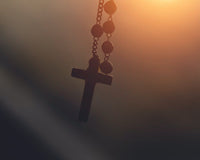
A rosary is a physical tool. 59 beads strung on a chain or cord. A crucifix hangs from one end. A centerpiece medal connects the pendant to the loop.
Each bead represents a specific prayer. You move your fingers bead to bead. The beads do the counting. Your mind does the meditating.
That’s what a rosary is for. It frees your thoughts from tracking numbers so you can focus on Christ.
The Prayer: A Meditation on Christ’s Life
The Rosary (capital R) is also the name of the prayer itself. It’s a structured sequence of prayers combined with meditations on 20 scenes from the lives of Jesus and Mary.
These scenes are called “mysteries.” Not mysteries like unsolved cases. Mysteries like sacred events too deep to fully understand.
The rosary prayer isn’t just repetition. It’s contemplation. Every Hail Mary is a chance to sit inside a Gospel scene and reflect.
The Rosary Meaning: “Crown of Roses”
The word comes from the Latin “rosarium.” It means “crown of roses” or “garland of roses.”
Each Hail Mary is like offering a rose to the Blessed Mother. Pray all five decades? That’s 50 roses. A full garland.
Mary has been associated with roses by saints for centuries. The rosary is a spiritual bouquet laid at her feet.
Learn more about the importance of the rosary and what it represents in Catholic life.
|
Rosary Term |
Meaning |
Why It Matters |
|
Rosarium (Latin) |
“Crown of roses” |
Each prayer = one rose offered to Mary |
|
Decade |
A group of 10 Hail Mary beads |
5 decades = 50 Hail Marys per session |
|
Mystery |
A sacred event from Christ’s or Mary’s life |
20 total mysteries for meditation |
|
Sacramental |
A blessed sacred object |
Rosary becomes sacramental once blessed by a priest |
|
Paternoster |
Latin for “Our Father” |
Original name for prayer bead strings |
|
Psalter of Mary |
150 Hail Marys (full rosary) |
Mirrors the 150 Psalms monks recited |
|
Bead (from Anglo-Saxon “bede”) |
“Prayer” |
The English word “bead” literally means prayer |
Where Did the Rosary Originate? The Full Rosary History
No single person invented the rosary. That’s the honest answer.
It grew over centuries. Layer by layer. Century by century. From pebbles to Paternosters to the 59-bead devotion you know today.
Here’s how it happened.
3rd-4th Century: Desert Fathers and the First Counting Tools
The rosary's history starts in the Egyptian desert.
Christian hermits, the Desert Fathers, prayed all 150 Psalms every day. To keep count, they dropped pebbles into a bag. One pebble per psalm.
Anthony of Egypt and Pachomius, two of the most famous Desert Fathers, are linked to the 4th-century development of knotted prayer ropes. 150 knots. Much lighter than a bag of rocks.
These ropes counted prayers to God only. No Hail Marys yet. No Marian devotion. Just the Jesus Prayer and the Psalms.
431 CE: The Council of Ephesus Changes Everything
At this council, the Church officially declared Mary “Theotokos”, “Mother of God.”
This decision opened the door for Marian devotion. Prayers to Mary began to grow. And the beads that counted prayers to God would eventually count prayers to His mother too.
590 CE: The Hail Mary Enters the Picture
Pope Gregory the Great introduced the Hail Mary during Mass on the Fourth Sunday of Advent.
But it wasn’t the Hail Mary you know. It was just one line from Luke’s Gospel: “Hail Mary, full of grace, the Lord is with thee.”
That’s it. No “Holy Mary, Mother of God.” That part came much later.
7th-8th Century: Irish Monks Formalize the Paternoster
Irish monks are credited with turning loose pebble-counting into a formal bead string.
They created the “Paternoster cord”, a string of 150 beads for reciting 150 Our Fathers. Illiterate monks who couldn’t read the Latin Psalms used this as a substitute.
By the 13th century, four trade guilds of bead makers existed in Paris alone. They were called “paternosterers.”
1050 CE: Elizabeth’s Words Added to the Hail Mary
“Blessed art thou among women and blessed is the fruit of thy womb.” Elizabeth’s greeting from Luke 1:42 was added.
Now people had a longer prayer to repeat on beads. And they started doing exactly that.
Early 1100s: The Hail Mary Goes Viral (Medieval Style)
St. Alvery recited 150 Hail Marys daily. He genuflected for 100 of them. Lay prostrate for 50.
Louis IX of France knelt 50 times every evening, each time reciting a Hail Mary.
By the 12th century, English monastic rules specified how 50 Hail Marys should be broken into five decades of ten. Sound familiar?
The beads grouped by 50 were called “Our Lady’s Psalter.”

Who Created the Rosary? The St. Dominic Story
Ask most Catholics who created the rosary. They’ll say, St. Dominic.
The truth is more complicated. And more interesting.
The Legend: Mary Gives Dominic the Rosary (1214 CE)
Here’s the traditional story. In 1214, St. Dominic was in southern France. He was fighting the Albigensian heresy, a belief system that rejected the physical world as evil.
During a period of intense prayer, the Blessed Virgin Mary appeared to him. She showed him a string of beads. She gave him specific prayers. She told him to teach this devotion to the people.
Dominic obeyed. The rosary became his most powerful tool against heresy. He founded the Dominican Order. And Dominicans became the principal promoters of the rosary for the next 800 years.
The History: It’s More Gradual Than That
Scholars have debated this story for centuries. Most agree the legend can’t be verified historically.
The rosary wasn’t invented in a single moment. It evolved over centuries. Desert monks. Irish Paternosters. Medieval bead-counting. Hail Mary repetition.
But here’s what’s undeniable: the Dominican Order made the rosary what it is today. They gave it structure. They gave it the mysteries. They spread it across Europe.
At least a dozen popes have acknowledged St. Dominic’s connection to the rosary. It’s honored as a “pious belief worthy of respect.”
Alan de Rupe: The Man Who Made It Popular (1470s)
If Dominic planted the seed, Alan de Rupe watered it.
This Dominican priest from Brittany saw the rosary as a tool for everyone. Not just monks. Not just priests. Everyone.
He established “Rosary confraternities”, groups where members pledged to pray 15 decades weekly and to pray for each other. The concept exploded across Europe.
|
Key Figure |
Century |
Contribution to the Rosary |
|
Desert Fathers (Anthony, Pachomius) |
3rd-4th |
Created knotted prayer ropes; counting prayers with pebbles |
|
Pope Gregory the Great |
6th |
Introduced the Hail Mary during Mass (first version) |
|
Irish monks |
7th-8th |
Formalized the Paternoster cord (150 bead strings) |
|
St. Dominic |
13th |
Tradition: received the rosary from Mary; Dominicans promoted it |
|
Dominic of Prussia |
15th |
Developed the Joyful, Sorrowful, and Glorious Mysteries (1410-1439) |
|
Alan de Rupe |
15th |
Established Rosary confraternities; mass popularized the devotion |
|
Pope Pius V |
16th |
Standardized the 15-decade rosary (1569); Battle of Lepanto (1571) |
|
Pope John Paul II |
21st |
Added Luminous Mysteries (2002); declared Year of the Rosary |
When Was the Rosary Created in Its Current Form?
The rosary you hold today didn’t exist before 1569. Not in this exact form.
Every century added a layer.
1410-1439: The Mysteries Are Born
Dominic of Prussia, a Carthusian monk (not to be confused with St. Dominic), transformed the rosary forever.
He added a sentence to each of the 50 Hail Marys, quotes from Scripture. Each decade got a unique meditation. He called it the “Life of Jesus Rosary.”
This was the breakthrough. Before this, the rosary was pure repetition. After this? It was a guided journey through Christ’s life.
The Joyful, Sorrowful, and Glorious Mysteries emerged. Three sets of five. Fifteen decades total.
1568: The Hail Mary Gets Its Final Form
The Council of Trent approved the complete Hail Mary as we know it.
“Holy Mary, Mother of God, pray for us sinners, now and at the hour of our death. Amen.”
That petition at the end? It wasn’t part of the prayer for the first 1,500 years. It was added during the Counter-Reformation.
1569: Pope Pius V Standardizes the Rosary
This is the answer to “when was the rosary created.” At least in its recognized form.
Pope Pius V, himself a Dominican, issued the papal bull Consueverunt Romani Pontifices. It officially established the devotion of the rosary: 15 decades, 3 sets of mysteries, specific prayers in sequence.
Everything before this was evolution. This was codification.
1571: The Battle of Lepanto and Our Lady of the Rosary
Two years later, the rosary got its miracle.
Pope Pius V asked Catholics across Europe to pray the rosary while the Christian fleet faced a much larger Ottoman navy at the Battle of Lepanto.
On October 7, 1571, the Christians won. Pius V attributed the victory to the rosary. He established the Feast of Our Lady of the Rosary on October 7. Catholics still celebrate it today.
1917: Fatima and the Rosary Revival
The Blessed Mother appeared to three shepherd children in Fatima, Portugal.
Her message? Pray the rosary every day for peace in the world.
She also gave them a new praye, the Fatima Prayer: “O my Jesus, forgive us our sins, save us from the fires of hell.” Most Catholics now add this after each decade.
2002: Pope John Paul II Adds the Luminous Mysteries
For 500 years, the rosary had three sets of mysteries. Then John Paul II proposed a fourth: the Luminous Mysteries.
Five meditations on Christ’s public ministry: Baptism, Wedding at Cana, Proclamation of the Kingdom, Transfiguration, Institution of the Eucharist.
He named October 2002 through October 2003 “The Year of the Rosary.” The rosary went from 15 to 20 mysteries.
What Does the Rosary Symbolize? Beads on Rosary Meaning
Every part of the rosary means something. Nothing is random.
The Crucifix: Where Prayer Begins
The crucifix isn’t just a starting point. It’s a reminder that everything in the rosary flows from the cross.
You hold it. You make the Sign of the Cross. You profess your faith with the Apostles’ Creed.
Before a single bead is touched, you’re declaring what you believe.
Learn more about the meaning of the Catholic crucifix and why it matters.
The 5 Decades: 50 Roses for Mary
Five groups of 10 beads. Each decade is one mystery. One scene from Christ’s or Mary’s life.
The decades of the rosary aren’t just counting units. They’re meditation stations. You spend 10 Hail Marys dwelling inside a single Gospel moment.
The Large Beads: Doorways Between Mysteries
Each large bead signals a shift. You’re leaving one mystery. Entering another.
You pray the Our Father here. The prayer Jesus Himself taught. It reorients your heart toward God before you dive into the next decade.
The Three Introductory Beads
On the pendant, after the first Our Father: three small beads for three Hail Marys.
They represent the three theological virtues: faith, hope, and charity. You’re asking for these before you begin meditating on the mysteries.
The Centerpiece Medal
Usually depicting Mary, a saint, or a holy event. This connects the pendant to the loop.
It’s the junction. The physical point where introductory prayers transition into the decades.
The Circle: Eternity
The loop of beads forms a circle. No beginning. No end.
It symbolizes eternal prayer. Ongoing devotion. The never-ending love between God and His people.
|
Rosary Part |
Count |
Prayer |
Symbolism |
|
Crucifix |
1 |
Apostles’ Creed |
Foundation of faith; Christ’s sacrifice |
|
1st large bead (pendant) |
1 |
Our Father |
Pope’s intentions; God’s sovereignty |
|
3 small beads (pendant) |
3 |
3 Hail Marys |
Faith, hope, and charity |
|
2nd large bead (pendant) |
1 |
Glory Be |
Transition to mysteries |
|
Large beads (loop) |
5 |
Our Father (x5) |
Doorways between mysteries |
|
Small beads (loop) |
50 |
Hail Mary (x50) |
50 roses offered to Mary |
|
Chain spaces |
5 |
Glory Be + Fatima Prayer |
Praise between decades |
|
Centerpiece medal |
1 |
None (transition) |
Connection; image of Mary or saint |
|
Full circle |
— |
All prayers combined |
Eternity; never-ending devotion |
The Rosary Prayer, Complete Step-by-Step Guide
Six core prayers. Twenty mysteries. One loop.
If you’ve never prayed the rosary before, this is your roadmap.
Step 1: Hold the Crucifix
Make the Sign of the Cross. Recite the Apostles’ Creed.
“I believe in God, the Father almighty, Creator of Heaven and earth…”
Step 2: The Pendant Prayers
First large bead: Our Father.
Three small beads: Hail Mary, Hail Mary, Hail Mary (for faith, hope, charity).
Chain space: Glory Be.
Step 3: Announce the First Mystery
At the first large bead on the loop, announce which mystery you’re meditating on. Then pray the Our Father.
The mystery depends on the day. Monday and Saturday: Joyful. Tuesday and Friday: Sorrowful. Wednesday and Sunday: Glorious. Thursday: Luminous.
Step 4: Pray the Decade
10 small beads. 10 Hail Marys. While you pray, meditate on the mystery.
After the 10th bead: Glory Be. Then the Fatima Prayer (optional but common).
Step 5: Repeat for All Five Decades
Announce the 2nd mystery. Our Father. 10 Hail Marys. Glory Be. Fatima Prayer.
Same for the 3rd, 4th, and 5th decades. Each decade gets its own mystery.
Step 6: Close the Rosary
After the 5th decade: Hail Holy Queen.
“Hail, Holy Queen, Mother of Mercy, our life, our sweetness, and our hope…”
Then the final prayer and the Sign of the Cross. Done.
For a portable version, try a rosary ring , 10 bumps on your finger for praying anywhere.

The Rosary Decades: All 20 Mysteries by Day
The prayers stay the same every day. The mysteries change.
That’s what keeps the rosary fresh across a lifetime of praying.
Joyful Mysteries (Monday and Saturday)
The Annunciation. The Visitation. The Nativity. The Presentation. The Finding of Jesus in the Temple.
God entering the world. Wonder. Anticipation. A young mother saying yes.
Luminous Mysteries (Thursday)
The Baptism in the Jordan. The Wedding at Cana. The Proclamation of the Kingdom. The Transfiguration. The Institution of the Eucharist.
Christ’s public ministry. Miracles. Teaching. Revelation.
Sorrowful Mysteries (Tuesday and Friday)
The Agony in the Garden. The Scourging at the Pillar. The Crowning with Thorns. The Carrying of the Cross. The Crucifixion.
The passion and death of Jesus. Friday’s rosary carries extra weight — it was the day He died.
Glorious Mysteries (Wednesday and Sunday)
The Resurrection. The Ascension. The Descent of the Holy Spirit. The Assumption of Mary. The Coronation of Mary.
Victory. Triumph. The empty tomb.
|
Day |
Mystery Set |
5 Mysteries |
Fruit/Theme |
|
Monday |
Joyful |
Annunciation, Visitation, Nativity, Presentation, Finding in Temple |
Humility, Joy, Poverty, Obedience, Devotion |
|
Tuesday |
Sorrowful |
Agony, Scourging, Thorns, Cross, Crucifixion |
Sorrow, Purity, Courage, Patience, Self-denial |
|
Wednesday |
Glorious |
Resurrection, Ascension, Holy Spirit, Assumption, Coronation |
Faith, Hope, Love, Grace, Perseverance |
|
Thursday |
Luminous |
Baptism, Cana, Proclamation, Transfiguration, Eucharist |
Openness, Fidelity, Conversion, Desire, Adoration |
|
Friday |
Sorrowful |
Agony, Scourging, Thorns, Cross, Crucifixion |
Sorrow, Purity, Courage, Patience, Self-denial |
|
Saturday |
Joyful |
Annunciation, Visitation, Nativity, Presentation, Finding in Temple |
Humility, Joy, Poverty, Obedience, Devotion |
|
Sunday |
Glorious |
Resurrection, Ascension, Holy Spirit, Assumption, Coronation |
Faith, Hope, Love, Grace, Perseverance |
Where to Get a Rosary That Carries Real Meaning
A rosary can be made of anything. Plastic from a factory. Glass from a craft store.
But the best rosaries come from somewhere that matters.
Olive Wood From Bethlehem
Olive wood rosaries connect your prayer to the land where Christ lived. The olive tree symbolizes peace, anointing, and God’s presence.
Jesus prayed among olive trees in Gethsemane. When you hold an olive wood rosary, you’re holding wood from that same species, that same soil.
Each bead has a unique grain. No two rosaries look alike.
Medjugorje Stone Rosaries
Made from actual stones gathered at Apparition Hill in Bosnia — where the Blessed Mother appeared in 1981.
Browse Medjugorje rosaries made by local artisans from the apparition site.
Crystal, Pearl, and Silver
For gifts. Baptisms. First Communion. Confirmation. Weddings.
These are the heirloom rosaries passed from grandmother to granddaughter.
Make Your Own
Grab a rosary making supply kit with Bethlehem olive wood beads, a crucifix, and threading tools. Making a rosary by hand is itself a meditative act.
Read about what to consider when buying a rosary as a gift.
Frequently Asked Questions About the Rosary
What is a rosary?
A rosary is both a prayer tool (59 beads on a string with a crucifix) and the prayer itself (a structured meditation on 20 mysteries from the lives of Jesus and Mary). The word comes from Latin “rosarium” meaning “crown of roses.”
What is a rosary for?
It’s for counting prayers while meditating on the life of Christ. The beads free your mind from tracking numbers so you can focus on each mystery. It’s the most popular private devotion in the Catholic Church.
Who created the rosary?
No single person. It evolved over centuries. The earliest counting tools came from Desert Fathers (3rd century). Catholic tradition credits St. Dominic (1214) with receiving the rosary from Mary. The Dominicans became its primary promoters.
When was the rosary created?
Prayer beads date to the 3rd-4th century. The mysteries were added in the 1400s. Pope Pius V standardized the rosary in 1569. Pope John Paul II added the Luminous Mysteries in 2002.
Where did the rosary originate?
In the Egyptian desert with the Desert Fathers, then developed through Irish monks, medieval European monasteries, the Dominican Order, and papal decrees over 1,700+ years.
What does the rosary symbolize?
A garland of roses offered to Mary. Each Hail Mary is a rose. The circle of beads represents eternity. The crucifix represents Christ’s sacrifice. The 5 decades represent 5 windows into the Gospel. See our guide on different types of rosary jewelry.
What is the rosary prayer?
A sequence of 6 core prayers (Apostles’ Creed, Our Father, Hail Mary, Glory Be, Fatima Prayer, Hail Holy Queen) prayed on 59 beads while meditating on one of 4 sets of mysteries depending on the day.
What do the beads on a rosary mean?
The 53 small beads represent Hail Mary prayers (50 in the decades plus 3 introductory), and the 6 large beads represent Our Father prayers. The word “bead” comes from the Anglo-Saxon bede, meaning “prayer,” so each bead represents a prayer.